🎈
IELTS Reading
Get ready for the IELTS Reading exam with a collection of practical resources and expert guidance. Learn how the test works, understand the scoring process, and develop effective techniques for answering questions quickly and accurately. Practice with sample tests, targeted exercises, and valuable tips that can help you reach your target band score.
IELTS Academic Reading vs IELTS General Training Reading
Both tests contain 40 questions and must be completed in 60 minutes. The main difference is the type of texts you read.
IELTS Academic Reading : features three long passages on academic topics such as science, technology, education, and history. The texts contain more advanced vocabulary and complex ideas, making the test more challenging.
IELTS General Training Reading : uses texts from everyday life, including advertisements, notices, workplace documents, and magazine articles. The language is generally more practical and easier to understand.
In short, Academic Reading is designed for university study, while General Training Reading focuses on real-life and workplace situations.
The most common question types are:
Multiple Choice – Choose the correct answer from a list of options.
True / False / Not Given – Decide whether statements agree with the information in the text.
Yes / No / Not Given – Similar to True/False/Not Given, but focuses on the writer's views or opinions.
Matching Headings – Match headings to the correct paragraphs or sections.
Matching Information – Find specific information in different parts of the text.
Matching Features – Match statements to people, places, theories, or other features.
Matching Sentence Endings – Complete sentences by choosing the correct endings.
Sentence Completion – Fill in missing words from the passage.
Summary Completion – Complete a summary using words from the text.
Note Completion – Fill in notes with information from the passage.
Table Completion – Complete a table with missing information.
Flow-chart Completion – Complete a process or sequence diagram.
Diagram Label Completion – Label parts of a diagram using words from the text.
Short Answer Questions – Answer questions using a limited number of words from the passage.
Understanding these question types and practising each one regularly can significantly improve your IELTS Reading score.
Types of questions on IELTS Reading :
IELTS Academic Reading marking scheme
The IELTS Academic Reading test is designed to assess your ability to understand academic texts similar to those used in universities and higher education settings.
Test Format
Duration: 60 minutes
Number of Passages: 3
Total Questions: 40
Maximum Score: 40 marks
Reading Passages
The test consists of three long reading passages taken from books, journals, magazines, and newspapers. Topics may cover science, technology, history, education, health, or environmental issues.
Question Types
You may encounter a variety of question formats, including multiple choice, matching headings, sentence completion, summary completion, True/False/Not Given, and short-answer questions.
Scoring
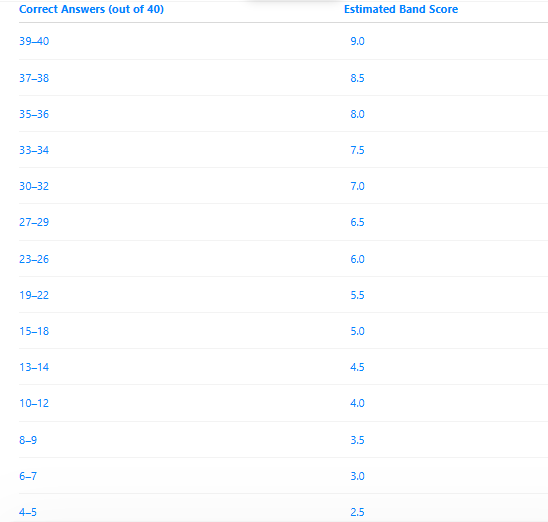
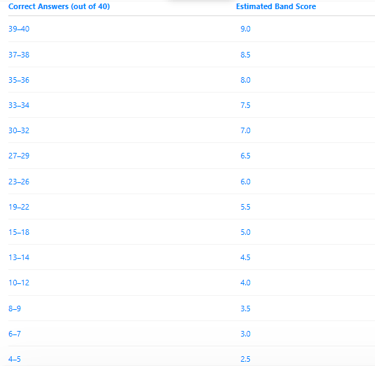
Each correct answer receives one mark. Your raw score out of 40 is converted into an IELTS band score ranging from 1 to 9.
Key Point
The Academic Reading test focuses on advanced vocabulary, complex ideas, and analytical reading skills, making it more challenging than the General Training Reading test.