🎈

What is IELTS Listening?
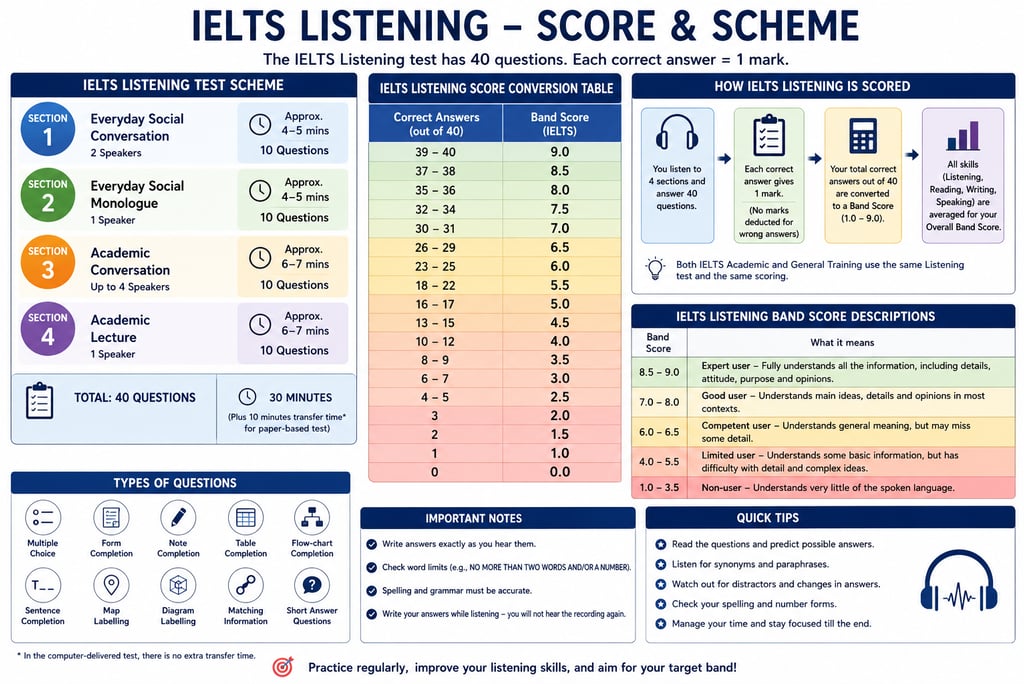
The IELTS Listening test measures how well you can understand spoken English in different situations. It is the same for both IELTS Academic and IELTS General Training.
Test Format
Total Questions: 40
Sections: 4
Time: Approximately 30 minutes
Extra Time: 10 minutes (paper-based test) to transfer answers
Computer-based IELTS: Answers are typed directly, so there is no extra transfer time.
IELTS Listening Sections
Section 1: Everyday Conversation
You will hear a conversation between two people in a social context.
Example Topics:
Booking a hotel
Joining a gym
Renting an apartment
Making an appointment
Difficulty: Easy
Section 2: Everyday Monologue
You will hear one person speaking about a general topic.
Example Topics:
A museum tour
Information about a park
School facilities
Community events
Difficulty: Easy to Moderate
Section 3: Academic Discussion
You will hear a conversation involving up to four speakers.
Example Topics:
University projects
Research discussions
Course assignments
Academic planning
Difficulty: Moderate
Section 4: Academic Lecture
You will hear a lecture or presentation by one speaker.
Example Topics:
Environmental science
History
Technology
Education
Difficulty: Most Difficult
Common IELTS Listening Question Types
Multiple Choice
Form Completion
Note Completion
Table Completion
Flow-chart Completion
Sentence Completion
Map Labelling
Diagram Labelling
Matching Information
Short Answer Questions
IELTS Listening Band Score Conversion
Academic & General Training
Important IELTS Listening Tips
1. Read the Questions First
Before the recording starts, quickly read the questions and underline keywords.
Example:
What time does the train leave?
Keywords:
time
train
leave
2. Predict the Answer
Think about what kind of information is needed.
Example:
Departure Time: ______
Possible answer:
A time (e.g., 8:30 AM)
3. Listen for Synonyms
The recording often uses different words from those in the question.
QuestionAudiocheapaffordablestartbeginbuypurchasedifficultchallenging
4. Watch Out for Distractors
Speakers often mention one answer and then change it.
Example:
We originally planned to meet on Friday, but we've moved it to Saturday.
✅ Correct answer: Saturday
❌ Wrong answer: Friday
5. Check Word Limits
If the instruction says:
NO MORE THAN TWO WORDS AND/OR A NUMBER
These are acceptable:
15
15 students
twenty-five
These are NOT acceptable:
15 university students (3 words)
Common Reasons Students Lose Marks
Spelling mistakes
Wrong plural forms
Ignoring word limits
Writing answers in the wrong place
Missing distractors
Poor concentration in Sections 3 and 4
Example IELTS Listening Question
Audio Topic: Hotel Reservation
Question:
Name: Sarah _______
Audio:
Good morning. My name is Sarah Wilson, and I'd like to book a room.
Answer:
Wilson
How to Improve IELTS Listening
✅ Listen to English every day
Recommended resources:
BBC Learning English
TED Talks
NPR Podcasts
IELTS practice tests
✅ Practice note-taking
✅ Learn common IELTS vocabulary
✅ Focus on spelling and numbers
✅ Complete at least 2–3 full listening tests each week
Target Scores
Band 5.0: Understand basic information.
Band 6.0: Suitable for many colleges and workplaces.
Band 7.0: Good user of English.
Band 8.0+: Very strong listening ability.
For most universities and scholarships, a score of 6.5–7.0 in Listening is a strong target.